


Flow Control
Instruments used to control the mass and/or volumetric flow-rates of dry gases and liquids ranging from 0.5 mL/min to 5000 L/min.
Liquid Flow Controllers
✕Laminar liquid flow controllers are designed to ensure precise and stable regulation of the volumetric flow rate of liquids.
They operate based on the principle of laminar fluid dynamics: when the liquid flows through a laminar flow element (usually a calibrated channel or tube), a pressure drop occurs between the inlet and the outlet of this element.
This pressure drop is proportional to the flow rate of the liquid. By measuring this pressure drop, the controller can:
• Calculate the flow rate in real time
• Compare the actual flow rate to the desired flow rate
• Actively adjust a valve or actuator to maintain the target flow rate
| Product name | |
|---|---|
|
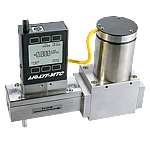
358 Series LC Liquid flow controllers |
Laminar Mass Flow Controllers
✕These controllers regulate the mass flow rate by measuring the pressure drop (or pressure loss) of the gas through a laminar restriction element, also known as a laminar flow element.
Advantages
• High accuracy in mass flow measurement.
• Fast response time, suitable for dynamic processes.
• Less sensitive to temperature and pressure variations compared to volumetric systems.
Typical Applications
• Research laboratories in chemistry or physics.
• Industrial process control involving gases.
• Calibration and standardization systems.


Thermal Mass Flow Controllers
✕Thermal mass flow controllers operate by measuring the amount of heat absorbed or carried away by a flowing gas. This principle relies on the specific heat capacity of the gas—that is, the amount of energy required to increase its temperature. By monitoring the temperature change within a heated flow, these devices can accurately calculate and control the mass flow rate, independently of ambient pressure or temperature.
| Product name | |
|---|---|

|
DFC Mass Flow Controller |

|
GFC |
Rotameters With Needle Valve
✕Variable area flow meters (also called rotameters) with a needle valve added at the inlet or outlet. They operate by allowing a float to move freely within a conical tube, where the float’s equilibrium height is proportional to the volumetric flow rate.


